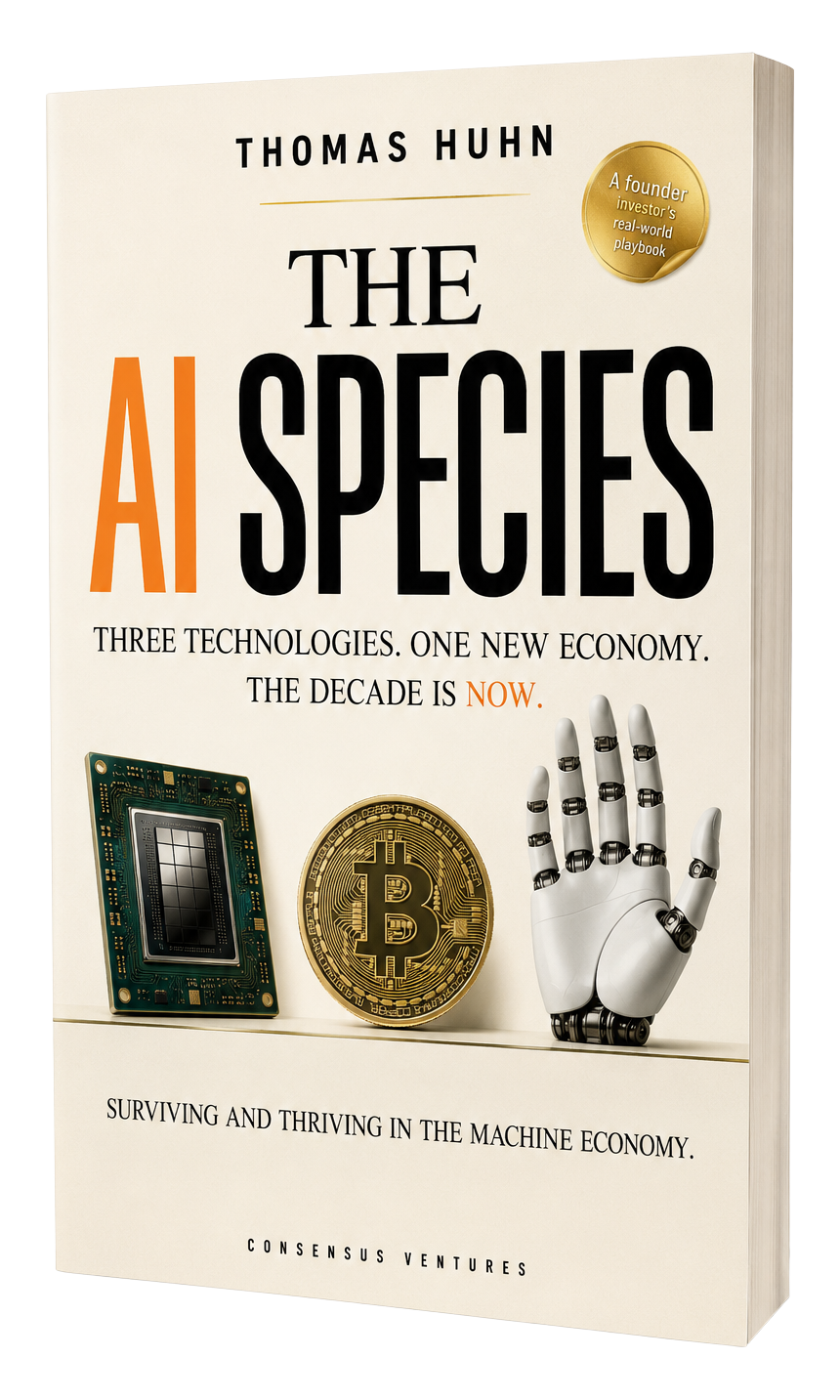
 Click to enlarge
English Edition · 2nd Edition · Paperback & eBook
Artificial intelligence isn't just replacing jobs. It's rewriting the rules of the economy.
Thomas Huhn builds AI products himself and has been investing at the intersection of AI, robotics, and crypto for over a decade. For 25 years he has been building software companies — and what he sees now is what drove him to write this book.
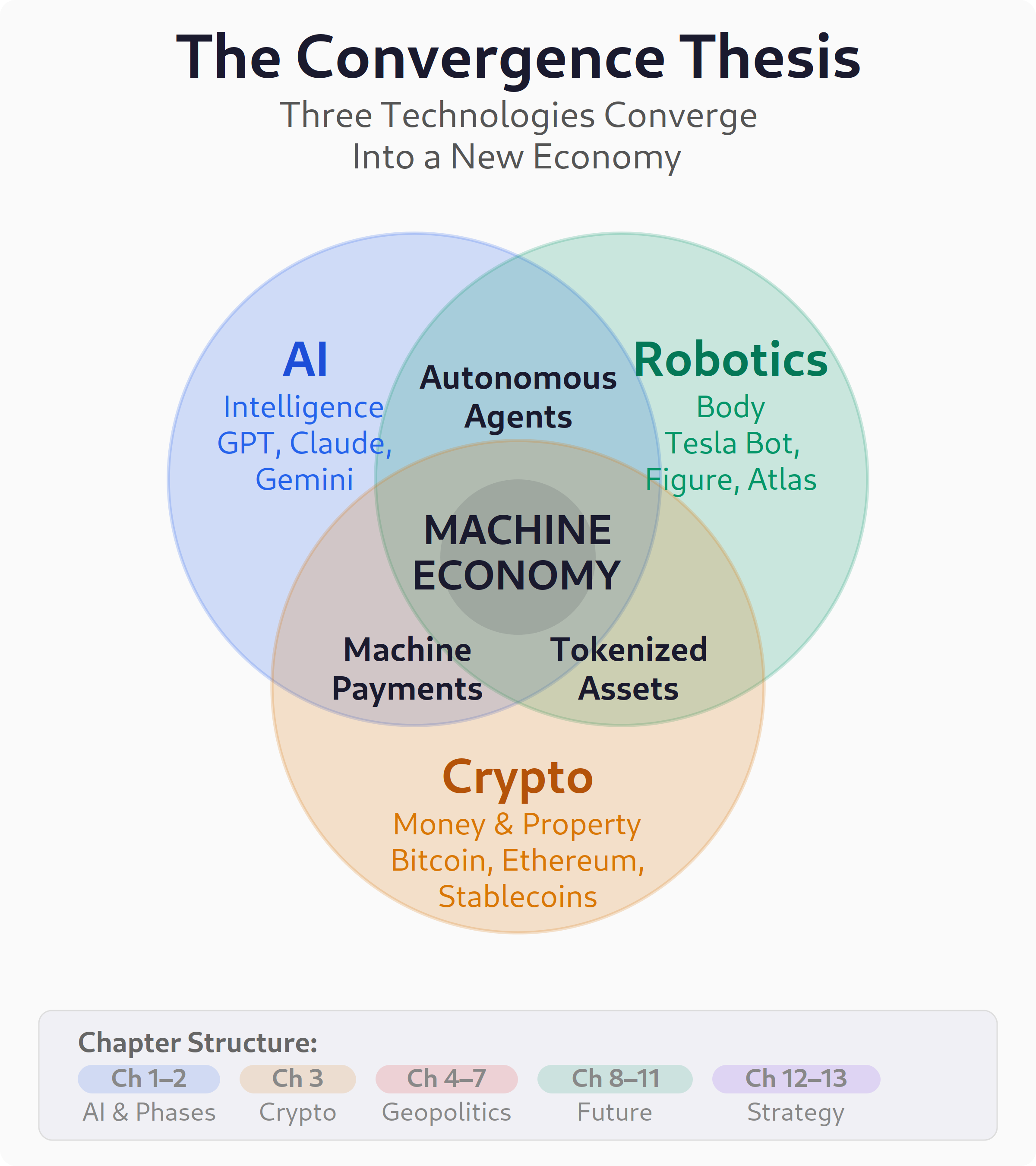
AI agents that act autonomously. Robots that work in factories and eventually our living rooms. And a crypto infrastructure that enables machines to do what they never could before: pay on their own, sign contracts, conduct business. Three technologies that each change the rules of the game on their own. Together, they create an economy where machines don't just produce — they also consume.
The AI Species is the unfiltered analysis of a practitioner with skin in the game. From the geopolitics of the chip war to AI's insatiable energy appetite to brain-computer interfaces. From the question of which jobs disappear to concrete portfolios and an action plan for investors who want to act rather than watch.
This book ends with a personal confession. And a dedication to the author's grandchildren, for whom technology optimism isn't an abstract attitude — it's a necessity.
Table of Contents
Part I: The Thesis
- At the Dawn of the Greatest Transformation in 250 Years — Why AI isn’t a trend, but a rewriting of the economic order
- The AI Revolution in Four Phases — From assistants to autonomous agents: the roadmap of the machine economy
- Why Machines Need Crypto — Autonomous machines need autonomous money. Why bank accounts don’t work
- When Everything Becomes a Token — Real-world assets, tokenization, and the programmable economy
- Stablecoins, Dollar Dominance, and the Debt Bomb — Why digital dollars could be the most dangerous financial innovation since CDOs
- The Toxic Trinity: CBDC, UBI, and Digital Feudalism — When the state wants control over your money
- When Machines Start Companies — DAOs, autonomous agents, and corporations without humans
Part II: The Terrain
- The Geopolitical Dimension: USA, China, and Europe’s Silence — Who wins the AI war — and why Europe isn’t even allowed to play
- Energy: The Invisible Bottleneck — Why Microsoft is buying nuclear power plants and AI is upending the energy market
- The Human Cost: Work, Purpose, and Social Upheaval — What happens when the middle class has no more work
- Regulation: The Elephant in the Room — EU AI Act, MiCA, and why well-intentioned is the opposite of good
Part III: The Future
- The Most Likely Scenario: 2026–2035 — A decade in the machine economy, year by year
- The Next Interface: From Keyboard to Thought — Neuralink, brain-computer interfaces, and the merging of human and machine
- Ethics and Philosophy of the Machine Economy — Consciousness, rights, responsibility: the questions nobody wants to ask
Part IV: The Playbook
- Immortality as an Investment Thesis — How AI is pushing the boundaries of aging
- The Barbell Strategy: A Portfolio for the Machine Economy — Nassim Taleb’s philosophy, applied to the AI revolution
- The Model Portfolio: Theory Meets Practice — Real positions, real allocation, skin in the game
- Risks and Counterarguments: What Can Go Wrong — The honest case against the thesis
- The Personal Stress Test: Surviving Volatile Markets — Psychology, discipline, and the art of not panicking
- Why Now: And Why Hesitation Is the Biggest Mistake — The action plan for the next 30 days
Epilogue & Appendices
- Epilogue: For Mila — The personal confession at the end of the book
- Acknowledgments
- Appendix A: The Children’s Portfolio — For Mila and Malou
- Appendix B: Glossary
- Appendix C: Implementation for German Investors
- Appendix D: Tokenomics Comparison
- Appendix E: Bibliography
Reading Sample: The Foreword
I didn’t write this book because the world needs another book about artificial intelligence. There are enough of those. Most are either utopian to the point of naivety or dystopian to the point of paralysis. Some promise paradise, others warn of doom. Both are entertaining. Both are useless.
I wrote this book because one sentence wouldn’t let me go. As an investor, as an entrepreneur, as someone who lives the pace of these changes every single day. A sentence the World Economic Forum published as its vision in 2016, one that has since gone viral:
“You’ll own nothing and be happy.”
I believe this is the biggest lie of our time.
Without ownership, you won’t be happy. Without ownership, you have no security. Without ownership, you have no bargaining power. Without ownership, you are dependent on those who do own things. That was true under feudalism, it was true in the industrial age, and it will be even more true in the machine economy.
The causal chain is brutally simple:
Machines replace labor. No labor income. No capital to invest. No wealth. Game over.
The window is closing. Not in decades. In years.
Because what happens when machines can not only think and act, but also have their own money — and eventually their own companies?
The answer to that question has consequences far beyond return tables. It affects how we work, how we invest, how we function as a society, and yes — how we turn today’s untreatable diseases into tomorrow’s treatable ones.
Reading Sample: Chapter 1
Chapter 1: At the Dawn of the Greatest Transformation in 250 Years
“The future is already here—it’s just not evenly distributed.” — William Gibson
The Tectonic Shifts of History
There are moments when the economic order shifts—not gently, but abruptly.
The steam engine was one such moment. When James Watt patented his improved engine in 1769[3], the immediate application was clear: pumping water out of coal mines. What nobody foresaw was the cascade that followed. The steam engine enabled factories, factories enabled mass production, which in turn required railroads for transport. Railroads created national markets, and national markets required banks and insurance companies. Within two generations, a single invention had rewritten the entire economic and social order of Europe.
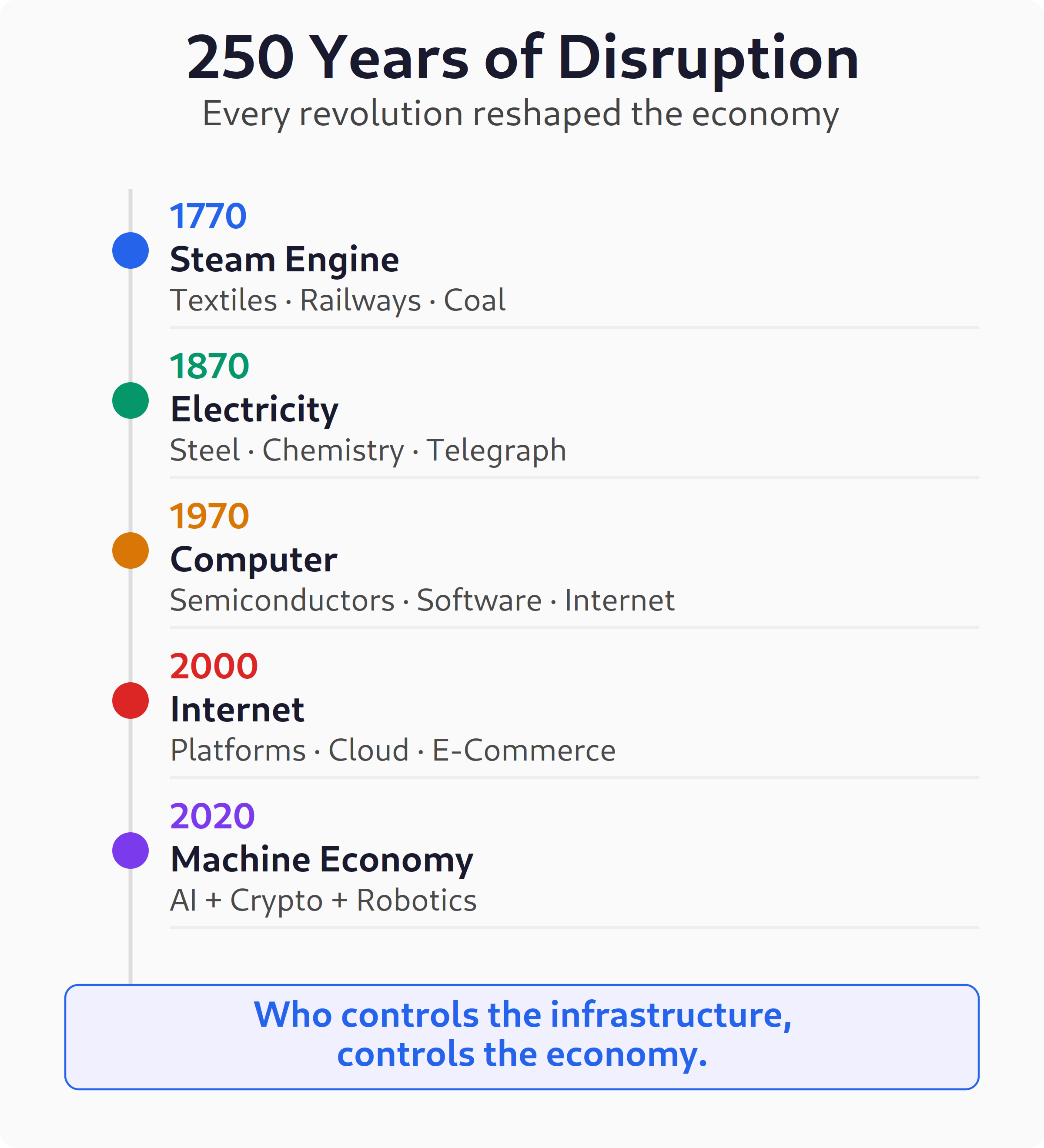
Electrification was the next break. In the 1880s, Thomas Edison powered up the Pearl Street Station in Manhattan—the world’s first commercial power generator.[4] Thirty years later, the entire industrial world ran on electricity. But the real revolution wasn’t light. It was the ability to distribute energy. Suddenly, factories no longer had to sit on rivers to harness water power. Machines could run anywhere. That changed the geography of production, the structure of cities, the rhythm of the human day. The electric lightbulb turned night into day and the night shift into standard practice.
Then the internet. In hindsight, the moment Tim Berners-Lee released the World Wide Web in 1991[5] was so obviously transformative that you wonder why everyone didn’t immediately bet everything on it. But that’s the fallacy of hindsight. In 1995, four years after launch, less than one percent of the world’s population used the internet.[6] Britain’s Astronomer Royal, Martin Rees, gave the internet in its current form “about as much future as CB radio."[7] Paul Krugman wrote in 1998: “By 2005 or so, it will become clear that the Internet’s impact on the economy has been no greater than the fax machine’s."[8] They weren’t just wrong. They were spectacularly wrong.
Those who invested during these inflection points—not in the technology itself, but in the right layer of the value chain—built wealth that lasted generations. The families who invested in railroad companies, not steam engines. The investors who bet on Standard Oil, not oil drilling equipment. The venture capitalists who funded Amazon and Google, not the fiber-optic cable manufacturers that went bankrupt in 2001.
The pattern is always the same: the technology itself is visible. The value layer that profits from it is not. And that’s exactly where the opportunity lies. Who made money during the great disruptions? And who didn’t? The parallels to earlier technology revolutions are instructive—but only if you look closely. Because in every disruption, most investors lost money, even when the technology ended up changing everything.
The British railway mania of the 1840s was the first great technology bubble in history.[9] Ordinary families poured their savings into railroad stocks. Hundreds of companies were founded—many existed only on paper. When the bubble burst in 1847, fortunes were destroyed. The technology was real—railroads changed the world. But most early investors lost anyway.
Who won? Not those who invested in railroad companies, but those who controlled the infrastructure. Cornelius Vanderbilt didn’t get rich by buying railroad stocks. He bought the railroads themselves, consolidated them, and controlled the network. J.P. Morgan earned his fortune not as an investor, but as the financier who organized the restructuring of bankrupt railroads. John D. Rockefeller built Standard Oil because railroads needed to transport oil. Andrew Carnegie built US Steel because railroads needed steel.
The pattern: the technology itself was a risky bet. The infrastructure around it was the safe one.
Electrification repeated the pattern. Thomas Edison built the first power grid and founded Edison General Electric. George Westinghouse bet on alternating current and built the competition. The “War of Currents” followed—one of the legendary business battles of the 19th century. In the end, Edison lost control of his own company, which merged into General Electric without his name in the title. Westinghouse went bankrupt and lost his company to creditors. The two inventors who made electrification possible profited the least.
Who won? Samuel Insull, a former Edison assistant who understood that the business wasn’t generating electricity—it was distributing it. Insull built an empire of utilities across the Midwest and became one of the richest Americans of his era. He controlled the infrastructure layer, not the technology.
The internet shows the same thing. In the dot-com bubble around 2000, investors lost trillions. Pets.com, Webvan, Kozmo.com—all the hyped startups built on top of the internet vanished. But the infrastructure survived. Cisco, which built the routers and switches that the internet flowed through, lost 80 percent of its market cap in the crash but recovered and is a profitable company today. Amazon fell from $113 to $5.97[10], survived, and became the most valuable company in the world. Google didn’t go public until 2004—after the crash—and built its dominance on infrastructure that others had built and paid for.
What does this teach us about the current convergence?
Three things.
First: the technology is almost always real. Railroads came. Electrification came. The internet came. AI, robotics, and crypto are coming too. Doubting that would be like doubting in 1995 whether the internet would catch on.
Second: most early investments fail anyway. Not because the technology was wrong, but because the price was too high, the company too weak, or the timing off. Of a thousand AI startups that exist in 2025, maybe fifty will still be relevant in 2035.
Third: the money flows to infrastructure, not applications. Vanderbilt, not railroad stockholders. Insull, not Edison. Amazon and Google, not Pets.com. In our thesis: NVIDIA, not the hundredth AI startup. Ethereum, not the hundredth token. That’s why the barbell strategy in Part IV emphasizes the infrastructure layer.
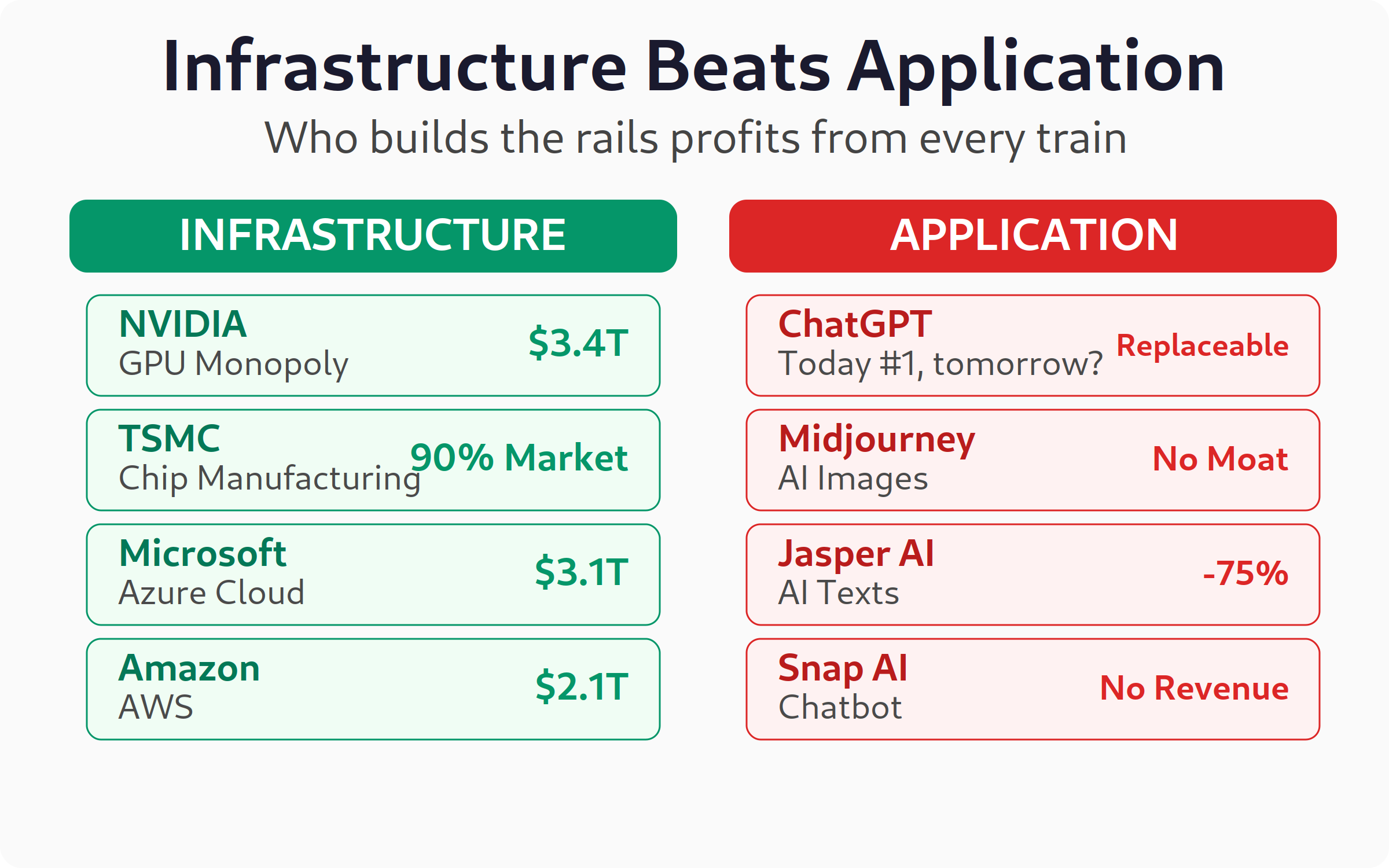
We are now at such a point. And this time, the transformation is more radical than anything we’ve seen.
Why “this time is different” actually is different this time
“This time is different”—four of the most dangerous words in investing, as Sir John Templeton once warned[11]. Every hype cycle claims to be new. The dot-com bubble claimed it. The housing bubble claimed it. Crypto in 2017 claimed it. And every time, the reckoning followed. So why should it be different this time? Because there is a qualitative difference between a technology that supports human labor and one that replaces it. Every previous technological revolution amplified human capabilities. The steam engine amplified muscle power, the computer amplified calculation, the internet amplified communication—but humans remained the actor in every case. They got better tools, but they remained the ones operating them. Artificial intelligence breaks this pattern. For the first time in human history, we are building systems that can think, learn, decide, and act without human guidance. Not within a narrow, predefined framework like a chess computer evaluating a board position, but in the open, unstructured world—from contract analysis to software development to medical diagnosis.
This is not incremental progress. It’s a category change.
The Four Economic Revolutions According to Emad Mostaque
Emad Mostaque, the founder of Stability AI, calls[12] this the “Intelligence Inversion”: the fourth and final economic upheaval in human history. After land, labor, and capital, intelligence itself is being inverted from a scarce resource to an abundantly available one. The earlier inversions always left a fallback: if you lost your land, you could sell your labor. If you lost your job, you could deploy capital. But when intelligence becomes abundant, it replaces the mind itself. “AI replaces the mind itself,” Mostaque writes[13] in his book The Last Economy, “making the Luddite analogy more dire.” The Luddites smashed looms and found other work. When the machine replaces not the hands but the head, there’s no obvious way out.
For the vast majority of people, labor was the only path to wealth. You sell your time, your knowledge, your skills. In return, you get money. With that money, you build assets. From assets come security, freedom, options.
When machines take over work—not just physical work, but intellectual work—that chain breaks.
Machines replace labor. No labor income. No capital to invest. No wealth.
That’s not a worst-case scenario. That’s the default path if you do nothing.
The good news: there is a way out. And the way out is ownership.
Those who own the machines that take over the work will profit from their productivity. Those who own the infrastructure they run on. Those who own the networks through which they pay.
This isn’t an investment thesis. It’s a survival strategy. Mostaque gives humanity a “Thousand-Day Window” for this.[14] A thousand days to set the course before the phase transition becomes irreversible. Not as a countdown to doomsday. As a deadline for decisions that no one will be able to make afterward.
Now connect that capability with robotics—give AI a physical body that can operate in the real world. Then hand it a payment system that works without banks, without bureaucracy, without human gatekeepers. What emerges is something that rewrites our entire economic order.
A machine that can think, that has a body, and that owns its own money.
That’s no longer an amplification of human capabilities. That’s the emergence of a new economic actor.
And that is what will happen over the next ten years. Not as a science fiction scenario, but as the logical, already-in-motion consequence of technologies that exist today and are improving exponentially.
I’m not a prophet—I’m a technology entrepreneur and investor. I’m not writing this book as a detached observer theorizing about technology from a university chair. I build AI products. Every day. With accessibleAI, I develop software based on large language models that helps companies automate regulatory compliance. I experience firsthand how fast this technology is evolving. I see how it’s changing work processes that had stayed the same for decades. I see how it’s calling entire professions into question. Not theoretically—concretely: people who seemed indispensable yesterday, whose tasks an AI agent now handles in minutes. And I invest. In Bitcoin and Ethereum, for years. In AI stocks. In robotics companies. With my own money, not my clients’. Taleb calls that the willingness to bear your own consequences. If my thesis is wrong, I lose money. That sharpens the analysis in a way no academic research can replace. This dual role sharpens the analysis. I can explain not just what is happening, but why it’s happening and how fast—because I know the development cycles from daily work. Peter Thiel wrote in Zero to One[2] that the most valuable companies are those doing something most people don’t yet believe is possible. Most people still don’t believe that AI agents will autonomously manage supply chains, negotiate contracts, and process payments within five years. They don’t believe that humanoid robots will work in factories by 2030. And they certainly don’t understand why these machines will need cryptocurrencies to function.
A Thesis That’s Never Finished
People often ask me when I realized that AI, crypto, and robotics belong together. They expect a story with an aha moment. An evening when everything clicked.
That’s not how it works.
The thesis developed over years, and it’s still not finished. There’s no point at which you can say: now I’ve understood it. Instead, there’s a series of moments when a new puzzle piece falls into place and the bigger picture comes into sharper focus.
When I first started understanding Bitcoin, it was about hard money—the question of whether a monetary system can exist that no government controls. Years later, when AI agents emerged that could act autonomously on the internet, I noticed something: these agents can’t open a bank account or make a wire transfer, but they can create a crypto wallet in ten seconds, without any human involvement. That’s when two separate interests became a single thesis.
Robotics came later. When Tesla unveiled Optimus and I started thinking through what happens when AI gets a body, it became clear: this isn’t a third technology alongside the other two. It’s the bridge between the digital and physical worlds. An AI with a robotic body and a crypto wallet is a complete economic actor. Think. Act. Pay.
My Own AI Experiment
And the convergence doesn’t stop. While I’m writing this book, things are happening that fit right into the thesis—things I wouldn’t have predicted a year ago. One example: In January 2026[223], an open-source project called[179] OpenClaw went viral. A single developer in Vienna had built a personal AI agent that runs on your own machine, autonomously operates programs, conducts research, writes code, and communicates through messenger apps. Within weeks, OpenClaw became the fastest-growing open-source project in AI history. By mid-February 2026, OpenAI had brought the developer on board.
Why does this matter? Because OpenClaw demonstrates exactly what this book describes. An AI agent that acts autonomously (Phase 3), that runs on local hardware (decentralized, not in some corporation’s cloud), and that augments a human user by independently completing tasks. The next logical step: this agent needs money. To pay for APIs, to buy compute time, to use services. And there we are again—back to crypto.
A theory that is constantly confirmed by new evidence from unexpected directions is stronger than one that rests on a single argument.
The convergence of AI, robotics, and crypto is not a finished topic. It’s a living system. And the pace at which new puzzle pieces are falling into place is accelerating.
There’s a reason, though, why many people can’t see this convergence even though the evidence is overwhelming: they’re thinking in the categories of an economy that is becoming obsolete. Emad Mostaque identified seven foundational assumptions in[15] The Last Economy that economic textbooks treat as truths—and that AI is turning into fictions. Two are especially relevant to this book. The first: “Markets find equilibrium.” In the analog world, that was approximately true. In digital markets, it’s false. Digital markets are self-reinforcing—they tend toward monopolies through network effects, not toward equilibrium. Whoever has the platform attracts the data, trains the better model, and attracts even more users. That’s not market distortion. That’s the physics of digital networks. The second: “Distribution follows contribution.” The old narrative says the market gives everyone what they deserve. In a world where a single AI model does the work of thousands, value doesn’t flow to the thousands who used to do the work. It flows to the few who own the model and the platform. That’s not a malfunction. It’s the logical consequence of a technology that drives the marginal cost of intelligence to zero. Anyone going into the next ten years with these assumptions won’t understand what’s happening.
How to Read This Book
Let me be transparent: this book is not a neutral overview of the state of technology. It’s a polemic—an argued, opinionated analysis with a clear thesis and concrete investment implications. I have convictions, and I lay them out openly. You can accept them, challenge them, or reject them. And above all: discuss them—with me and with others. On TheAiSpecies.world, there’s a forum where exactly that can happen. But I think it’s more honest to disclose my perspective than to hide behind supposed neutrality.
You already know the structure from the foreword: four parts, from the thesis through the terrain and the forward look to the concrete playbook. What I’d add here: this book is written so that each chapter also works on its own. If you’re an investor who wants to jump straight to the portfolio, you can do that. But the conviction you need to not sell during a crash—that only comes from following the argument from the beginning. My advice: read in order. The thesis builds on itself, and each layer supports the next.
This book is written for people who sense that something is changing and who are looking for a clear, argued framework to understand that change and act on it. If you’re one of those people, read on.
The machines are coming. And they’re creating their own economic order.
Key Takeaways:
◆ AI, robotics, and cryptocurrency are converging into the greatest economic transformation since the steam engine.
◆ Unlike previous transformations, all three are happening simultaneously and accelerating each other.
◆ Infrastructure investors have historically profited most—not the application hypes.
Also Available in German
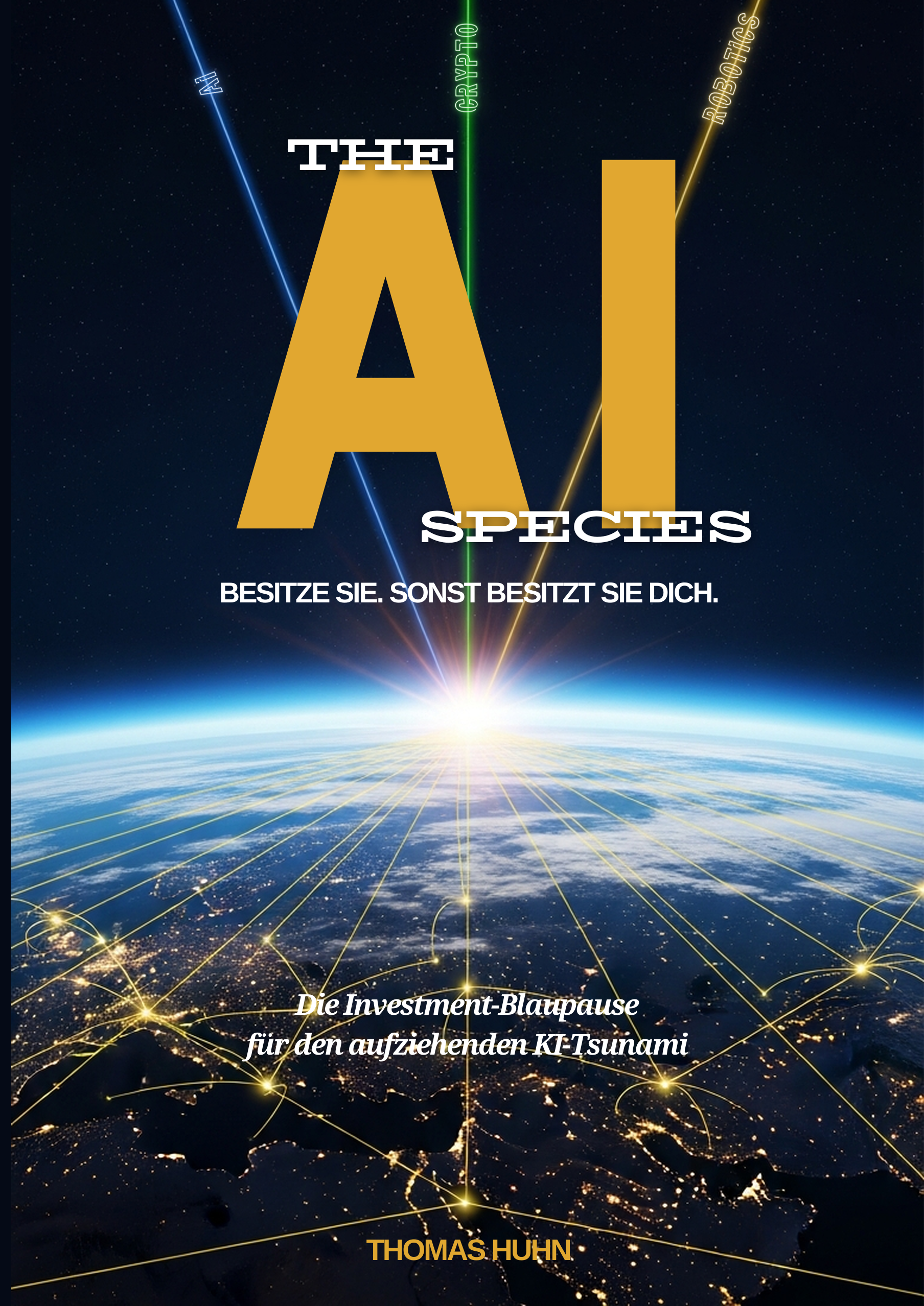
The AI Species — Vorsorge und Souveränität in der Maschinenökonomie.
Deutsche Ausgabe · Taschenbuch & eBook